

Menopause & Mature Skin · Guide
Your skin feels rough and flaky, so you reach for a scrub, and suddenly your face stings for two days. Here is why exfoliating works differently after menopause, which methods suit mature skin, how often to do it in winter, and the signs you need to back off.

The short answer
Yes, most women can keep exfoliating after menopause, but more gently and less often. After 50, skin replaces its outer layer more slowly, so dry flakes build up,3 and its barrier takes longer to repair itself, so scrubs and strong acids irritate sooner.4 Swap grainy scrubs for a soft washcloth or a mild acid such as a PHA,28 start once a week, keep exfoliating and retinoid nights apart, moisturize right after,2 and wear sunscreen every day if you use an AHA.6
01Should you still exfoliate after menopause?

Exfoliating removes the dead cells that sit on the surface of your skin. Done well, it leaves skin feeling smoother, helps it look brighter, and lets moisturizer spread more evenly. Done too often or too hard, it leaves skin red, tight and stinging.
After menopause, the line between the two gets thinner. The American Academy of Dermatology (AAD) notes that as estrogen levels fall, skin becomes thinner, and that exfoliation or microdermabrasion may help, but suggests seeing a dermatologist before you try them, because treatments done at home can do more harm than good on thinner skin.1
So the answer is not to stop. It is to change how you do it. Most women in their 50s and 60s do best with gentle methods, fewer sessions and a lot more moisture afterward, especially from November to March, when cold air and indoor heat leave skin flakier than usual.
02Why does exfoliating feel harsher after 50?
Three things change at once, and together they explain why the scrub you used at 40 can feel like sandpaper now.
Your skin sheds more slowly
In a classic study of epidermal renewal, the outer layer of skin took about 20 days to replace itself in young adults. In older adults it took more than 10 days longer, and renewal dropped sharply after age 50.3 Dead cells linger, so skin feels rough and looks flaky or dull. That is the part exfoliation helps with.
Your barrier repairs more slowly
Researchers who compared adults aged 20 to 30 with adults over 80 found that older skin was damaged by fewer tape strips (18 versus 31) and, 24 hours later, had restored only about 15% of its barrier function, against about 50% in the younger group. They traced the problem to a shortage of the lipids that hold the outer layer together.4 That is the part exfoliation can make worse: every scrub or acid creates a little damage that older skin takes longer to fix.
Estrogen, dryness and winter add up
Falling estrogen is linked with thinner, drier skin that holds less water,15 and low humidity and cold temperatures weaken the skin barrier further.10 In winter, skin is both flakier and easier to irritate, which is exactly when most of us are tempted to scrub harder.

03Which exfoliant is best for mature skin?
The AAD sorts at-home exfoliation into two kinds: mechanical (a brush, sponge or scrub) and chemical (alpha and beta hydroxy acids). For dry, sensitive or acne-prone skin, it suggests a washcloth and a mild chemical exfoliant, because mechanical methods can irritate.2 Most skin after menopause fits at least one of those descriptions.
| Method | What it does | After menopause |
|---|---|---|
| Soft washcloth | Lifts loose flakes while you cleanse | A good everyday option for dry, sensitive skin2 |
| PHA (gluconolactone) | A larger, slower acid that loosens dead cells | Similar results to AHAs in one study, with less stinging8 |
| AHA (glycolic, lactic) | Loosens the bonds between surface cells | Effective, but raises sun sensitivity; keep it mild6 |
| BHA (salicylic acid) | Exfoliates the surface and inside pores | Useful on oily or clogged areas; patch test first9 |
| Grainy scrubs, brushes | Rubs cells off by friction | Often too rough for thinner, drier skin12 |
04Are AHAs like glycolic and lactic acid safe for aging skin?
They can be, and they have real evidence behind them. In a split-arm study of sun-damaged skin, a 25% lotion of glycolic, lactic or citric acid used for about six months increased skin thickness by about 25%, with more collagen and better-quality elastic fibers under the microscope.7 That was a strong, study-only formula used on forearms, but it shows why dermatologists still value these acids for photoaged skin.
After four weeks of a glycolic acid cream, skin's sensitivity to UV damage at the cell level roughly doubled on average, and sensitivity to UV redness rose by 18%. The effect faded within a week of stopping.6
The catch is the sun. Because of that study, the FDA recommends that AHA products carry a sunburn alert and tell users to wear sunscreen, cover up and limit sun exposure while using the product and for a week afterward.6 An expert panel also concluded that glycolic and lactic acid products are safe for consumers at 10% or less with a pH of 3.5 or higher, when they protect against sun sensitivity or tell users to use daily sun protection.6
What actually helps
- Choose a leave-on AHA at 10% or less, not a peel-strength product.6
- Use it at night, and wear SPF 30 or higher every morning, including cloudy winter days.
- If an AHA stings, switch to a PHA or go back to a washcloth.
05Are PHAs and salicylic acid gentler?

PHAs: the mild option
Polyhydroxy acids such as gluconolactone are larger molecules than glycolic acid. In a 12-week study that compared a PHA routine with a glycolic acid routine, both improved photoaged skin, measured by clinical grading, skin replicas and elasticity.8
The PHA routine was better tolerated, and stinging and burning were significantly worse with the glycolic acid at both 6 and 12 weeks. The glycolic acid did a little more for sallowness (17.1% versus 12.4% improvement).8 For reactive skin after menopause, that trade is usually worth it.
Salicylic acid: for oily or clogged spots
Salicylic acid is the beta hydroxy acid most often used in cosmetics. An expert panel considers it safe when formulated to avoid irritation and sun sensitivity, and the FDA advises patch testing a small area first, stopping if irritation or long-lasting stinging occurs, and using sun protection.9 If you are dealing with menopause breakouts or a shiny T-zone, use it only where you need it, not over dry cheeks.
06How often should you exfoliate after menopause?
There is no single number. The AAD says it depends on your skin type and the method, that the more aggressive the method, the less often you should use it, and that over-exfoliating leaves skin red and irritated.2 A sensible plan for mature skin:
- Start once a weekUse one gentle method on one evening, and watch how your skin feels over the next two days.
- Go to twice a week only if skin stays calmNo stinging when you apply moisturizer, no new tight or shiny patches.
- Cut back in winterDry, heated air already stresses the barrier,10 so many women need less exfoliation from November to March, not more.
- Use a light handThe AAD suggests about 30 seconds of small, circular motions with a scrub or chemical exfoliant, light strokes with a brush, lukewarm water, and no exfoliating over cuts or sunburn.2
- Moisturize right awayExfoliation can be drying, so apply moisturizer immediately afterward.2
07Can you exfoliate if you use retinol or retinal?
Yes, but not on the same night. The AAD warns that prescription retinoids and retinol can make skin more sensitive or prone to peeling, and that exfoliating on top of them can worsen dryness or even trigger breakouts.2
A retinoid also does part of the job for you. It keeps surface renewal moving, so many women who use one at night need very little extra exfoliation. Retinal (retinaldehyde) is a good fit for mature skin: in an 18-week trial of 125 people with sun-damaged facial skin, a retinal cream reduced measured wrinkles and roughness and was well tolerated, while prescription retinoic acid caused more irritation.11 If your retinoid already stings, read our guide to retinol irritation after menopause before adding any acid.

Our pick for rough, flaky texture
Retinal 0.2% Barrier Serum
Retinaldehyde at 0.2% in a barrier-supporting base, made for mature, sensitive skin. Used at night, it keeps texture looking smoother so you can scrub less.
Shop Retinal 0.2%Simple rule: exfoliation night and retinal nights are separate evenings. If either one starts to sting, pause the exfoliant first.
08What are the signs you are over-exfoliating?
Over-exfoliated skin rarely looks dramatic. It tends to show up as:
- Stinging or burning when you apply a plain moisturizer
- Redness that lasts more than a day
- A tight, shiny, almost polished look
- More flaking, not less
- New small bumps or a rough, sandpapery feel
Reports to the FDA show what happens when exfoliation goes too far. Of 114 adverse reactions reported for AHA products between 1992 and 2004, the most common were burning (45), rash (35) and swelling (29), and the more serious ones appeared most often with products that exfoliate the most, such as skin peelers.6
What actually helps
- Stop all exfoliants, and pause your retinoid for a few nights.
- Cleanse with a mild, non-soap cleanser and lukewarm water.1
- Apply a rich moisturizer morning and night until skin feels comfortable again.
- Restart with the gentlest method, once a week.
- Swelling, blisters or burning that does not settle are reasons to see a doctor.

Our pick for after exfoliating
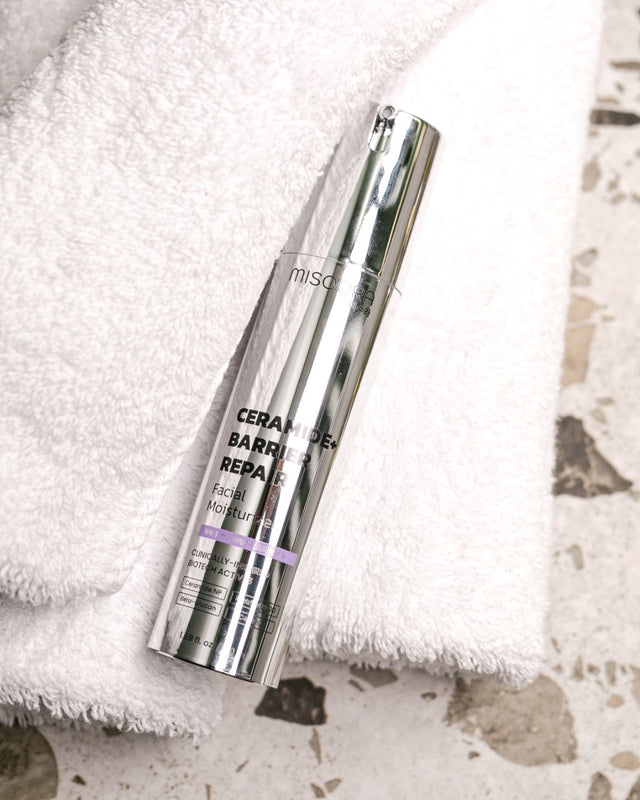
Ceramide+ Barrier Repair Moisturizer
A rich, fragrance-free ceramide cream for dry, mature skin. Apply it right after exfoliating to help skin feel soft and comfortable and look calmer by morning.
Shop Ceramide+09A gentle exfoliation routine for winter
This is the schedule we suggest for dry, mature skin in the colder months: one gentle exfoliation evening a week, and retinal on most other evenings. Keep sunscreen every morning.
Exfoliation night
Once a week, never on a retinal night


Retinal nights
Most other evenings, as your skin allows


Want the whole routine in one box? The Evening Routine Set covers every retinal night, and the Skin Recharge Set adds the morning steps.


Key takeaways
- After 50, skin sheds its outer layer more slowly, so flakes build up.3
- Older skin also repairs its barrier more slowly, so exfoliation irritates sooner.4
- For dry or sensitive skin, a washcloth or a mild acid beats grainy scrubs.2
- PHAs gave similar anti-aging results to glycolic acid with less stinging in one 12-week study.8
- AHAs raise sun sensitivity, so wear sunscreen daily and for a week after you stop.6
- Start once a week, keep exfoliation and retinoid nights apart, and moisturize right away.2
FAQ
Is it OK to use a face scrub after 50?
A soft washcloth is usually a better choice. The AAD notes that mechanical methods can irritate dry or sensitive skin,2 and skin gets thinner after menopause.1 If you love a scrub, use it lightly and no more than once a week.
Can I exfoliate every day after menopause?
Most mature skin does not tolerate daily exfoliation. The AAD warns that over-exfoliating leaves skin red and irritated.2 Once or twice a week is plenty for most women in their 50s and 60s.
Should I exfoliate before or after retinol?
Neither. Use them on different evenings. Exfoliating on top of a retinoid can worsen dryness and peeling.2
Does exfoliating help dry, flaky skin in winter?
Gently, yes. A washcloth or mild acid lifts loose flakes so moisturizer can work. But dry winter air already weakens the barrier,10 so pair it with a rich moisturizer and see our winter plan for dry skin after menopause.
Do I need sunscreen if I only exfoliate at night?
Yes. The FDA found that sensitivity to UV rose after weeks of AHA use, and it recommends sun protection while using AHAs and for a week afterward.6
When should I see a dermatologist?
Before trying microdermabrasion or peels,1 and any time exfoliation causes swelling, blisters or burning that does not settle within a day or two.
References
- American Academy of Dermatology. Skin care during menopause.
- American Academy of Dermatology. How to safely exfoliate at home.
- Grove GL, Kligman AM. Age-associated changes in human epidermal cell renewal. Journal of Gerontology. 1983;38(2):137–142.
- Ghadially R, Brown BE, Sequeira-Martin SM, Feingold KR, Elias PM. The aged epidermal permeability barrier. Journal of Clinical Investigation. 1995;95(5):2281–2290.
- Thornton MJ. Estrogens and aging skin. Dermato-Endocrinology. 2013;5(2):264–270.
- U.S. Food and Drug Administration. Alpha hydroxy acids.
- Ditre CM, et al. Effects of alpha-hydroxy acids on photoaged skin: a pilot clinical, histologic, and ultrastructural study. Journal of the American Academy of Dermatology. 1996;34(2 Pt 1):187–195.
- Edison BL, Green BA, Wildnauer RH, Sigler ML. A polyhydroxy acid skin care regimen provides antiaging effects comparable to an alpha-hydroxyacid regimen. Cutis. 2004;73(2 Suppl):14.
- U.S. Food and Drug Administration. Beta hydroxy acids.
- Engebretsen KA, Johansen JD, Kezic S, Linneberg A, Thyssen JP. The effect of environmental humidity and temperature on skin barrier function and dermatitis. Journal of the European Academy of Dermatology and Venereology. 2016;30(2):223–249.
- Creidi P, et al. Profilometric evaluation of photodamage after topical retinaldehyde and retinoic acid treatment. Journal of the American Academy of Dermatology. 1998;39(6):960–965.
Written by MISOORA Editorial. This article is for general information and is not medical advice. Skincare results described are cosmetic and vary from person to person. If you have concerns about changes in your skin, talk to your doctor or a board-certified dermatologist.